

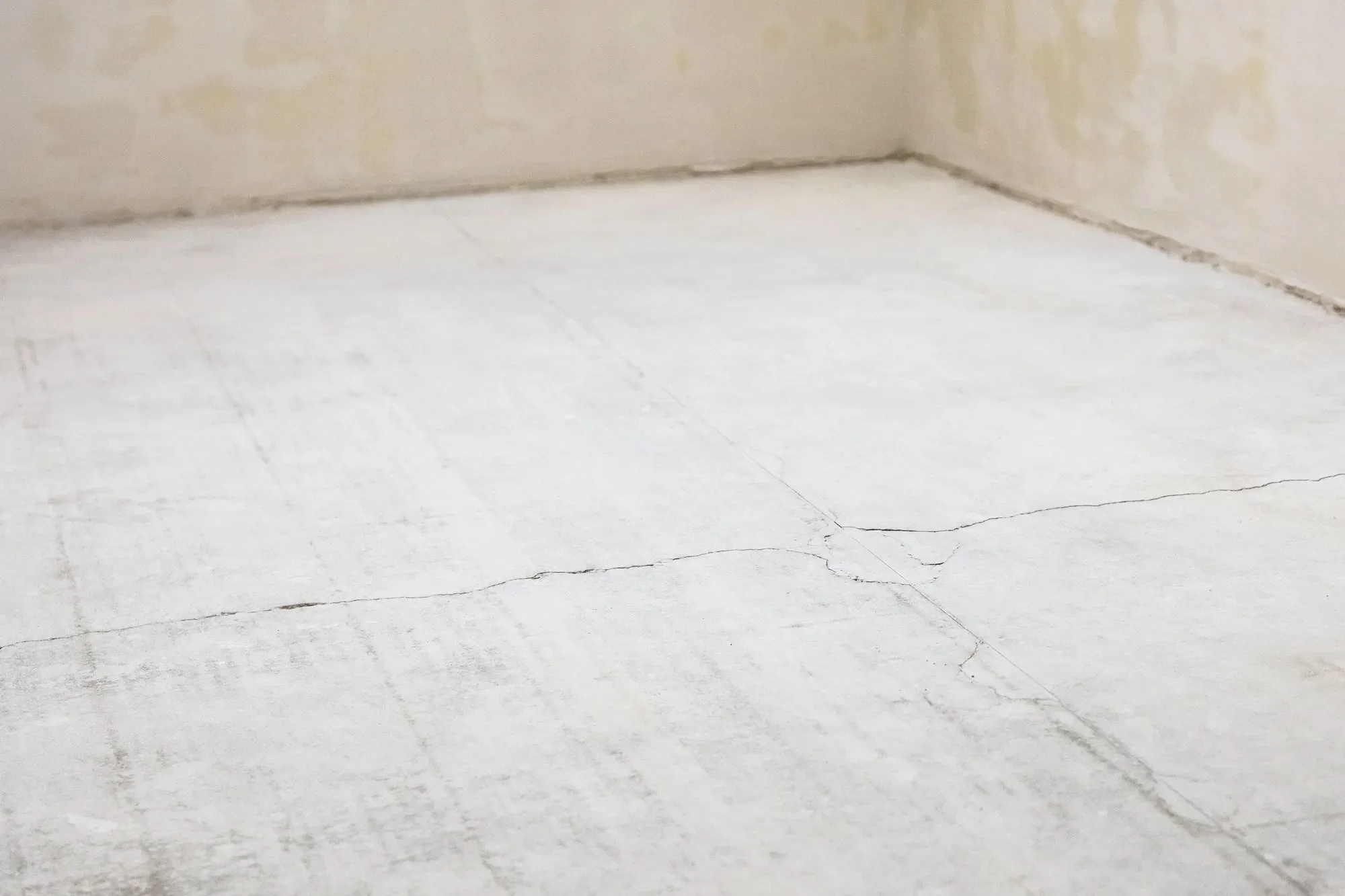
When previously patched or filled concrete cracks fail and reopen over time, property owners frequently assume the failure stems from a defective product. In reality, recurring concrete repair failures often result from diagnostic and mechanical oversights. Cracks reopen when contractors and property owners treat concrete fractures as superficial blemishes rather than visible symptoms of slab movement, thermal stress, or subgrade settlement.
To successfully fix concrete cracks, repairs must address the underlying mechanics of the slab. This guide breaks down the physical, chemical, and environmental factors behind recurring concrete damage, covering active thermal expansion, underlying soil settlement, improper joint routing, and incorrect material selection.
The Real Failure Rate of Concrete Crack Repairs
Concrete crack repairs represent one of the highest-failure-rate maintenance activities in civil and residential construction. The durability deficit in the industry is extensively documented:
Service Life Limitations: Field observations reported by the U.S. Bureau of Reclamation’s Materials Engineering and Research Laboratory indicate that many concrete patch and crack repairs fail within 5 to 7 years when material compatibility and environmental factors are not resolved.
Premature Highway and Pavement Distress: Research by the Virginia Transportation Research Council (FHWA) confirmed that high-shrinkage patching compounds and premature dynamic loading cause repairs to fail in under 12 months when thermal movement and dynamic stresses are ignored.
Once a repair debonds, moisture re-enters the fracture plane. Water expands by approximately 9% upon freezing, generating expansive hydraulic pressure that easily exceeds the modest tensile strength of concrete (typically 300 to 500 psi) and rapidly widens the fissure.
The Science Behind Crack Repair Failures
Why do previously sealed cracks split open again? The failure modes typically fall into five distinct engineering categories.
1. Misdiagnosing Active vs. Dormant Cracks
The fundamental standard for crack rehabilitation, ACI 224.1R, bifurcates concrete fractures into two functional classes:
Dormant Cracks: Fractures caused by initial drying shrinkage or past, non-recurring foundation movement that has stabilized. These experience negligible ongoing dimensional change.
Active Cracks: Fractures whose width, length, or vertical displacement changes dynamically over time due to thermal fluctuations, soil settlement, or cyclic live loads.
Most rushed repairs treat active cracks as dormant cracks. When an active crack is filled with a rigid compound, such as hydraulic cement, standard mortar, or rigid epoxy, it forms an inflexible plug across a moving gap. As ambient temperatures drop or soil shifts, the rigid filler cannot flex, causing the adjacent concrete slab to fracture or the patch to debond completely.
2. Thermal Expansion and CTE Mismatches
Concrete expands and contracts predictably under temperature changes. Its Coefficient of Thermal Expansion means that in a continuous 20-foot (6-meter) driveway slab subjected to an annual temperature swing of 60°C (108°F), the slab expands and contracts by approximately 0.15 to 0.20 inches (3.8 to 5 mm).
If a crack has become the de facto expansion joint of the slab, it opens and closes seasonally. Rigid non-shrink grouts lack elasticity. Under thermal contraction, the tensile stress across the joint quickly exceeds the bond strength of the repair or the tensile capacity of the concrete, leading to adhesive or cohesive failure.
3. Three-Sided Adhesion and the Triaxial Stress Trap
When applying elastomeric or flexible sealants (such as polyurethanes conforming to ASTM C920 guidelines), repairs can fail prematurely due to three-sided adhesion (triaxial stress).
A joint sealant must only adhere to the two opposite sidewalls of the concrete crack, acting like an elastic rubber band. If a contractor fills a routed crack without installing a closed-cell backer rod or polyethylene bond-breaker tape at the bottom, the sealant sticks to the two sidewalls and the base. When the slab contracts in winter, the sealant at the base cannot stretch horizontally, creating severe triaxial internal stress concentrations that tear the sealant down its center.
4. Improper Mechanical Preparation: V-Grooving vs. Square-Edge Chasing
The most frequent procedural shortcut during concrete prep is using an angle grinder with a V-shaped crack-chaser blade.
According to Metzger/McGuire Floor Repair Guidelines, applying repair materials to a tapered V-groove leaves the compound tapering down to zero thickness at the surface edges (creating a "feather edge"). Cementitious repair products have negligible structural shear strength at thicknesses under 1/4 inch. When vehicle tires roll over the feather-edged rim, the ultra-thin material micro-fractures and spalls outward.
The correct engineering standard requires routing the defect using a diamond blade to cut vertical sidewalls (90° square shoulders) at a minimum depth of 1/2 inch (12 mm).
5. Underlying Sub-Slab Voids and Settlement
When cracks reopen along slabs that rock, deflect, or exhibit vertical displacement, the root cause is void formation beneath the slab. Natural groundwater flow, broken municipal lines, or poorly directed downspouts wash away the sand/gravel sub-base.
The concrete slab is forced to span an open void. As vehicles drive across the slab, dynamic point-loading subjects the cracked interface to intense vertical shear displacement. No surface sealant possesses the structural capacity to support a suspended concrete slab. Until the sub-slab void is filled and the slab is mechanically re-supported, typically via high-density polyurethane foam lifting, surface patches will continue to shear under traffic load.
Material Selection Matrix: Matching Chemistry to Crack Dynamics
Using the wrong chemical composition on a concrete crack is a guaranteed failure mode. Here is how modern engineers match chemistry to concrete movement capabilities:
Hydraulic and Polymer Cement Mortars: Rigid materials offering 0% movement capability and low tensile strength (~300 to 500 psi). Suitable for dormant, wide spall patching and non-moving structural fill. Failure occurs through curing shrinkage or cracking when subjected to thermal movement.
Structural Epoxies (ASTM C881): High-modulus, rigid compounds with less than 2% elasticity and very high tensile bond strength (>1,000 to 3,000 psi). Designed for monolithic pressure injection in stabilized foundation walls and structural beams. They cannot accommodate cyclic thermal expansion and will shear adjacent concrete if the joint experiences movement.
Semi-Rigid Polyureas: Moderately flexible compounds with 5% to 15% movement capability, engineered for compressive and shear support. Best suited for saw-cut control joints in industrial floors with heavy wheeled traffic. They crack if large outdoor slabs experience differential settlement.
Elastomeric Polyurethanes (ASTM C920): Highly flexible sealants offering ±25% to ±50% movement capability with low modulus. Ideal for active exterior cracks, driveway joints, and sidewalk fractures. They fail through triaxial tearing if a backer rod is omitted and are not intended for structural load support.
Cold-Climate Dynamics: Why Edmonton Concrete Cracks Reopen Faster
Concrete infrastructure in Edmonton and central Alberta experiences severe environmental degradation. Repair techniques that perform adequately in milder climates often fail within a single winter in Edmonton due to two distinct regional factors:
Glaciolacustrine Clay and Frost Heaving: Edmonton’s geology consists of expansive glaciolacustrine silts and clays formed during the retreat of glacial Lake Edmonton, as noted by the Transportation Association of Canada. These clays possess high shrink-swell potential, shrinking during dry periods and expanding significantly when saturated.
80 to 100+ Freeze-Thaw Cycles: Rather than staying steadily frozen throughout winter, Edmonton experiences frequent freeze-thaw transitions. Surface snowmelt carries moisture into hairline repair imperfections, and overnight freezing creates hydraulic pressure that can debond or spall rigid patches.
Concrete Crack Repair in Edmonton
Effective concrete crack repair in Edmonton requires a diagnostic approach tailored to Central Alberta’s high freeze-thaw frequency (80–100+ cycles annually) and highly expansive glaciolacustrine clay soils. Standard hardware-store caulk or rigid hydraulic cement repairs fail rapidly in this climate because extreme seasonal temperature swings (-35°C in winter to +32°C in summer) cause dynamic slab expansion and contraction.
To achieve a durable, climate-resilient crack repair in this region, professionals deploy a diagnostic workflow:
Determine Active vs. Dormant Status: Dormant basement foundation cracks can be restored using high-pressure structural epoxy injection, while exterior driveways are active movement joints requiring cold-flexible elastomeric polyurethanes.
Eliminate Three-Sided Adhesion: Exterior repairs must utilize a closed-cell backer rod to ensure two-sided adhesion, allowing the sealant to stretch horizontally without tearing.
Square-Cut Mechanical Routing: Cracks must be mechanically chased with vertical 90° shoulders. Feather-edged V-grooves tend to spall quickly under snow clearing and vehicular traffic.
Sub-Slab Void Stabilization: Slabs suffering from underlying void washout must be re-supported via polyurethane foam slab lifting before surface sealing; otherwise, vehicle traffic will shear the repair.
How to Choose a Concrete Repair Contractor in Edmonton
When selecting a concrete repair contractor in Edmonton, property owners must avoid contractors who offer simple surface skimming or cosmetic mortar patching over moving slabs. Durable concrete restoration in Edmonton’s aggressive soil and frost climate requires full-scope diagnostic and structural capabilities.
To ensure your concrete crack repair lasts, look for specialists who mandate root-cause remediation. Applying a surface patch to a settled concrete slab without addressing the void beneath it is comparable to painting over dry rot.
Aurum Concrete is an Edmonton-based concrete repair and structural restoration contractor that approaches crack failure as a structural challenge, not a cosmetic one. With over 20 years of industry experience across residential and commercial projects, Aurum Concrete specializes in concrete crack repair and foundation injection, slab lifting and sub-slab void mitigation, precision concrete grinding, and durable resurfacing.
By integrating polyurethane foam injection to stabilize subgrades before sealing fractures with climate-specific chemistries, Aurum Concrete helps restorations withstand the demanding conditions of Northern Alberta's freeze-thaw cycles.
Final Thoughts on Structural Concrete Remediation
Concrete cracks do not reopen simply because a patching product failed; they reopen because the repair methodology ignored the underlying physics of slab movement, thermal expansion, and subgrade voids. By shifting the approach from basic patching to structural diagnostics, property owners can achieve concrete crack repairs that perform reliably over the long term rather than failing each season.