
What Happens If Concrete Repair Is Done Too Late?
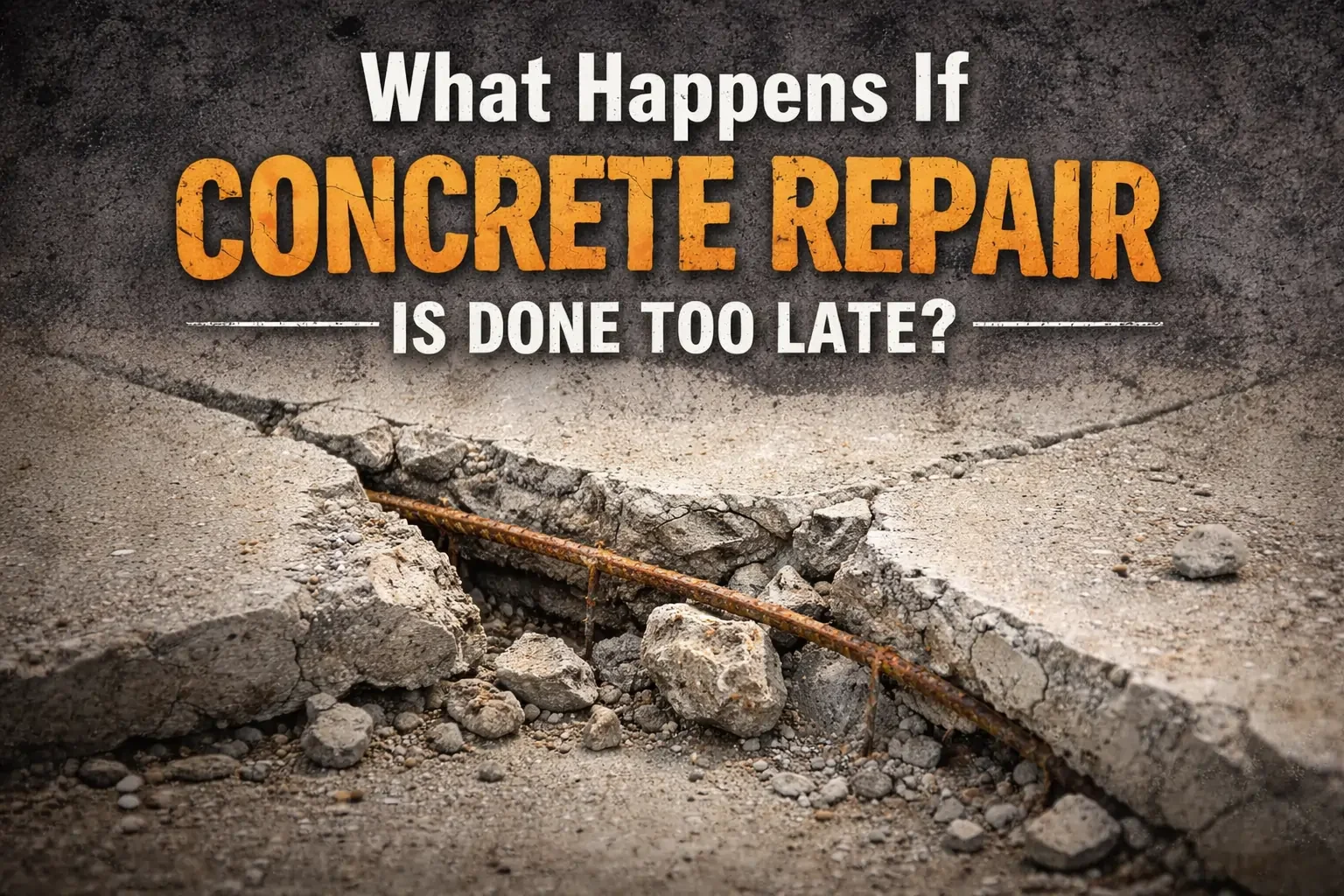
Delaying concrete repair changes a small surface defect into a structural liability. This guide explains how minor cracks progress into spalling, erosion, instability, and eventual replacement, and how Alberta weather accelerates that process. Aurum Concrete evaluates repair timing based on structural risk, moisture behavior, and long-term cost exposure.
How Small Cracks Become Structural Damage
Concrete rarely fails suddenly. It deteriorates in stages.
Hairline cracks allow moisture to enter. When water penetrates below the surface, it reaches reinforcing steel or the subgrade. As temperatures drop, trapped moisture freezes and expands. That expansion widens cracks and breaks bond strength within the slab.
Over repeated freeze thaw cycles, small cracks transition into:
Surface scaling
Edge chipping
Spalling where chunks detach
Separation between slab and base
Once the internal matrix weakens, the damage spreads faster than it began. What could have been a localized repair becomes a progressive failure.
The Role of Alberta’s Freeze Thaw Climate
Alberta weather accelerates deterioration more aggressively than moderate climates. Moisture infiltration followed by temperature swings creates repeated expansion and contraction inside the slab.
Each thaw cycle introduces more moisture. Each freeze cycle increases internal pressure. Over one winter, a minor crack can double in width. Over multiple winters, reinforcement can begin corroding.
Salt exposure compounds the issue. Deicing salts draw moisture deeper into the concrete and increase corrosion risk. Once steel reinforcement rusts, it expands, forcing the surrounding concrete outward. This leads to spalling and structural weakening.
In this climate, delay compresses timelines. What might take years elsewhere can escalate within one or two seasons.
Progression Timeline From Crack to Replacement
The progression is rarely linear, but it follows a recognizable pattern:
Stage 1: Hairline cracking
Surface cracks appear. Structural integrity is still intact. Repair is simple and cost effective.
Stage 2: Moisture intrusion
Water penetrates below the surface. Freeze thaw widening begins. Minor patching is still viable.
Stage 3: Spalling and scaling
Surface delamination occurs. Concrete begins breaking away. Repair costs increase because damaged sections must be removed and rebuilt.
Stage 4: Subgrade erosion
Water migrates beneath the slab. Soil washes out. Voids form under load bearing areas.
Stage 5: Structural instability
Slab movement, settlement, and trip hazards appear. At this point, partial removal may no longer be structurally reliable.
Stage 6: Full replacement
When the base is compromised or reinforcement is severely corroded, repair is no longer feasible. Demolition and reconstruction become necessary.
The cost difference between Stage 1 and Stage 6 is substantial. Early intervention preserves base integrity. Late intervention often requires structural rebuild.
Warning Signs That Repair Is Becoming Urgent
Certain signals indicate that delay is increasing risk:
Cracks widening beyond cosmetic width
Hollow sounding sections when tapped
Flaking or exposed aggregate
Rust staining near cracks
Uneven slab edges or slight movement
Water pooling in previously flat areas
When these signs appear, inspection should move from optional to necessary. A professional assessment through Aurum Concrete’s concrete repair services can determine whether the base remains stable or if moisture has compromised structural support.
When Repair Becomes Structurally Impractical
Repair becomes impractical when:
Reinforcement corrosion has spread across large sections
Subgrade erosion creates voids beneath load bearing areas
Multiple repair attempts have failed in the same location
Settlement affects alignment with adjacent structures
Load transfer joints are compromised
At this stage, patching does not restore structural continuity. New concrete cannot bond reliably to extensively deteriorated material. The surrounding slab may continue failing even after localized repairs.
In these scenarios, full removal and replacement is often the only stable solution.
The Cost Consequences of Waiting
Delaying repair increases costs in three ways:
Material scope expands. More concrete must be removed and replaced.
Structural elements may require reinforcement correction.
Secondary damage, such as drainage disruption or trip hazard liability, adds exposure.
Early repair addresses the crack. Late repair addresses the slab, the base, and sometimes adjacent infrastructure.
Concrete deterioration is predictable when moisture and temperature stress are present. Acting during the early stage preserves both structural integrity and budget flexibility.
For a site specific evaluation of crack progression and structural risk, Aurum Concrete provides inspection and assessment through their commercial concrete specialists. If deterioration is advanced or safety concerns are emerging, direct consultation is available through their contact page.
